Every Mid-South state lets you shoot 6 ducks a day, but not 6 of anything. Inside that 6, certain species have their own smaller limits: hen mallards, wood ducks, pintails, canvasbacks, redheads, scaup, black ducks and mottled ducks. Shoot one too many of the wrong bird and you're over your limit, even if your strap only holds four ducks.
That's why duck identification isn't a nice extra. It's part of hunting legally. This guide covers the birds that trip people up most on Mid-South public land, especially early in the season and in the low light of a timber hole. Limits link to the official regulations; the ID tips are from experience. For photos and calls of each species, see our duck ID guide.
The 2026-27 limits that make ID matter
All four Mid-South states use a 6-duck daily limit for 2026-27. The species limits inside it:
| Species | Arkansas | Mississippi | Tennessee | Louisiana |
|---|---|---|---|---|
| Mallards (total / hens) | 4 / 2 | 4 / 2 | 4 / 2 | 4 / 2 |
| Wood ducks | 3 | 3 | 3 | 3 |
| Pintails | 3 | 3 | 3 | 3 (1 hen) |
| Canvasbacks | 2 | 2 | 2 | 2 |
| Redheads | 2 | 2 | 2 | 2 |
| Black ducks | 2 | 2 | 2 | 1 |
| Mottled ducks | 1 | 1 | 1 | 0 first 15 days, then 1 |
| Scaup | 1 | 1 through Dec 17, 2 from Dec 18 | 1 through Dec 17, 2 from Dec 18 | 1 first 15 days, then 2 |
Sources: AGFC Guidebook p. 1; MDWFP Digest; TWRA Guide p. 55; LDWF Regulations p. 36. All checked Oct 22, 2026.
Possession limits are three times the daily limit in each state. Not confirmed The MDWFP Digest also says "except on opening day, unless otherwise noted" without giving an opening-day limit; that detail is Not confirmed (check the official source). Each species page in our duck ID guide shows the full limit box for Arkansas, Mississippi and Tennessee.
Rule one: if you can't identify it, don't shoot it
That sounds obvious, but most over-limit tickets come from hunters who shot at a shape. In flooded timber the birds are often backlit, coming through limbs, at 25 yards, with three people shooting. Agree with your group before the hunt: call your shots, and only shoot birds you've identified. A missed opportunity costs you nothing. An extra pintail or a hen mallard over the limit can cost you a fine and your season.
Teal: small, fast, low
Teal are the smallest ducks you'll see regularly, and they fly like it: tight, twisting flocks low over the water, often buzzing the decoys before you can get your gun up.
Green-winged teal are the teal of the Mid-South winter. They show up in good numbers when the weather turns cold and often stay all season.
- Drake: chestnut head with a green swoosh behind the eye, gray sides, a vertical white bar on the side of the chest, and a creamy-yellow patch under the tail.
- Hen: small, brown and mottled, with a green speculum (the wing patch) and a dark line through the eye.
- In flight: tiny, fast, with a green speculum and no big pale shoulder patch.
Blue-winged teal mostly pass through early. Many are already south by the regular season, but a few linger.
- Drake: slate-blue head with a white crescent in front of the eye, spotted tan body.
- Hen: brown, with a broken eye ring and a faint pale spot near the bill.
- In flight: a big powder-blue patch on the front of the wing. That's the giveaway. Shovelers have the same blue patch but a huge spoon bill and a bigger body.
Teal count toward the 6-duck total with no separate limit in the regular season in all four states (AGFC; LDWF).
Check the rules and the water
Confirm this season’s rules on our state law pages or the agency’s own site, check draw and permit deadlines, and look at today’s river levels on the migration map. Areas can close or flood on short notice.
Wood ducks: the limit people blow first
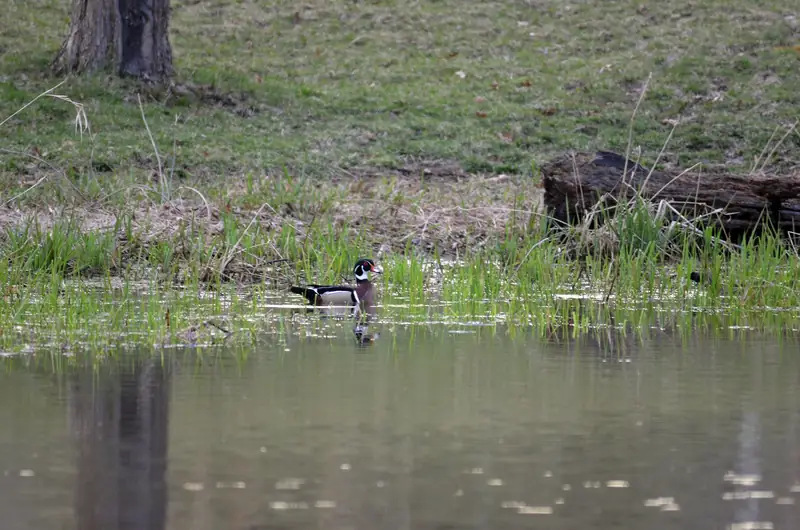
Wood ducks are everywhere in Mid-South timber, especially early, and they're limited to 3 a day in every state here. They often come in first thing, in small groups, fast and twisting through the trees.
- Drake: unmistakable when you can see it: a slicked-back green-and-purple crest, red eye, white chin straps, chestnut chest. In poor light, look for the long, squared-off tail and the head held up.
- Hen: gray-brown with a white teardrop around the eye. That eye patch is visible at a surprising distance.
- In flight: a long tail, a big head, and the bill pointed down at an angle. They often call a rising, squealing "oo-eek" as they fly.
- Confused with: hen teal at a glance in poor light. Wood ducks are noticeably bigger, with a longer tail, and they fly with their head up and bill down.
A practical tip: in a wood-duck-heavy spot, have one person keep count out loud. It's easy for a group to lose track when the first fifteen minutes is a flurry of woodies.
Hen mallards and look-alikes
The mallard limit is 4 a day with no more than 2 hens in all four states. Drakes are easy. Hens are where people go wrong, because several brown ducks look alike in a hurry.
- Hen mallard: mottled brown, an orange bill with a dark saddle in the middle, a blue speculum bordered in white on both sides, and whitish tail feathers.
- Hen gadwall: similar brown, but with a thinner orange-sided bill, a steeper forehead and a white square on the back of the wing in flight. Gadwall count toward the 6 with no separate limit.
- Black duck: much darker brown body than a hen mallard, with a paler head and a purple-blue speculum with little or no white border. Limited to 2 in Arkansas, Mississippi and Tennessee, and 1 in Louisiana.
- Mottled duck: a Louisiana and Gulf Coast bird. Lighter and warmer brown than a black duck, with an unmarked yellow bill and a thin white border mostly on the back edge of the speculum. Louisiana allows none for the first 15 days of the season and then 1 a day (LDWF p. 36).
When you're not sure whether a brown duck is a hen mallard, treat it as one and count it. That keeps you under your hen limit either way.
Pintails: long and slender
Pintails are big, elegant ducks, often high and wary.
- Drake: chocolate head, a white stripe running up the neck, gray body and the long, needle-like tail.
- Hen: slim, plain gray-brown with a long neck and a pointed tail, and a gray bill.
- In flight: long neck, long tail, narrow wings, and a white trailing edge on the speculum.
Arkansas, Mississippi and Tennessee allow 3 pintails; Louisiana allows 3 with no more than 1 hen (LDWF).
Divers: canvasbacks, redheads and scaup
Diving ducks show up on big open water, reservoirs and river backwaters. Three of them have their own limits.
- Canvasback: a long, sloping, wedge-shaped head and black bill. Drakes have a chestnut-red head and a very white back. Limit: 2 in all four states.
- Redhead: a rounder head, and a blue-gray bill with a black tip. The drake's back is gray, not white. Limit: 2.
- Scaup (bluebills): drakes have a dark head, black chest, gray-white back and a blue bill; hens are brown with a white patch at the base of the bill. Arkansas allows 1 a day. Mississippi and Tennessee allow 1 through Dec 17 and 2 from Dec 18. Louisiana allows 1 for the first 15 days, then 2 (MDWFP; TWRA p. 55; LDWF p. 36).
- Ring-necked duck: often confused with scaup. Look for the white ring near the tip of the bill and a peaked head. Ringnecks count toward the 6 with no separate limit.
How to get better at ID
- Watch before you hunt. Spend an afternoon at a refuge overlook with binoculars. A compact 8x42 from a well-reviewed line, such as Vortex's Diamondback, which Sportsman's Warehouse and Bass Pro Shops both carry, is plenty.
- Learn wing patches. In flight and low light, the speculum and shoulder patches are often all you'll see clearly.
- Learn silhouettes and flight style. Teal twist low and fast. Woodies fly head-up, bill-down. Pintails look long. Divers fly fast and straight on quick wingbeats.
- Study your birds in hand. After every hunt, look at what you shot. The more birds you see up close, the faster you'll recognize them in the air.
- Use our species pages. Each one in the duck ID guide has photos of the drake, hen and bird in flight where we could find properly licensed ones.
FAQ
How many wood ducks can I shoot in the Mid-South?
3 a day in Arkansas, Mississippi, Tennessee and Louisiana for 2026-27, within the 6-duck limit (AGFC; TWRA; LDWF, checked Oct 22, 2026).
How do I tell a hen mallard from a gadwall?
The hen mallard has an orange bill with a dark center and a blue speculum bordered in white; the gadwall has a white patch on the back edge of the wing and a steeper forehead.
Do teal have their own limit during regular duck season?
No. They count toward the 6-duck daily total (AGFC).
How many scaup can I shoot in Tennessee?
1 a day through Dec 17 and 2 a day from Dec 18 (TWRA Guide p. 55).
Dates, rules and prices on this page were last checked Oct 22, 2026. If an agency page and this article disagree, the agency page wins.
See something wrong or out of date? Report a correction.
We hunt public water in the Mid‑South and write from the agencies’ own pages. Every rule, date and fee links to its official source and shows the day we checked it. Where we couldn’t confirm something, we say so.
How we check our facts