Opening weekend is the busiest few days on Mid-South public land all year. Ramps that sit empty in January have a line of trucks at 3 a.m. Sloughs that hold one party most of the season hold five. Most hunters are decent people who just want a fair shot at a good morning, but crowded water brings out the worst in a few, and a single bad encounter can sour a whole season.
This guide covers how to share public water on the opener: who has the spot, how far apart to set up, how to handle boats and lights in the dark, and the written rules in each state that back all of this up. The etiquette comes from years on these WMAs. The rules link to the agencies.
When the Mid-South openers fall in 2026
| State / zone | Regular duck season opens | Source |
|---|---|---|
| Louisiana West Zone | Nov 14, 2026 | LDWF |
| Arkansas | Nov 21, 2026 | AGFC |
| Louisiana East Zone | Nov 21, 2026 | LDWF |
| Mississippi | Nov 27, 2026 | MDWFP |
| Tennessee | Nov 28, 2026 | TWRA |
All checked Oct 22, 2026. Mississippi and Tennessee open over the Thanksgiving holiday, which adds family-weekend traffic. Expect crowds everywhere.
Who has the spot?
On most freelance public water, the first party there has the spot. That's the custom everywhere, and some places write it down. Cache River National Wildlife Refuge in Arkansas, for example, says the first party at a location has it unless they invite others, and requires 100 yards between parties (Cache River NWR). Tennessee's Tier 4 blinds work the same way by rule: the first person or party there before legal shooting time has exclusive use until shooting hours end (TWRA).
"First there" means set up and hunting, not "I parked here last night" or "my buddy's on his way." If you pull up to a hole and see decoys out or a headlamp in the woods, the spot is taken. Go somewhere else, quietly.
A few situations that come up every opener:
- Two parties arrive at once. Talk. Offer to split the water or flip a coin. Most people are reasonable when someone simply asks.
- Someone sets up right on top of you. Politely tell them how many are in your party and where you're shooting. Many crowding problems happen in the dark, and the other party honestly doesn't know you're there.
- Someone is clearly in the wrong and won't move. Don't escalate. Move if you can, note what happened, and report real violations (like shooting within a closed area or over the limit) to a wildlife officer. Arguing on the water at 6 a.m. never ends well.
How far is far enough?
Where there's a written rule, follow it:
- Cache River NWR: 100 yards between parties (USFWS).
- Tennessee draw areas: temporary blinds and decoys must be at least 200 yards from any Tier 1, 2 or 4 blind location (TWRA).
- Reelfoot WMA: temporary blinds at least 200 yards from any permanent blind (Tenn. Comp. R. & Regs. 1660-01-02).
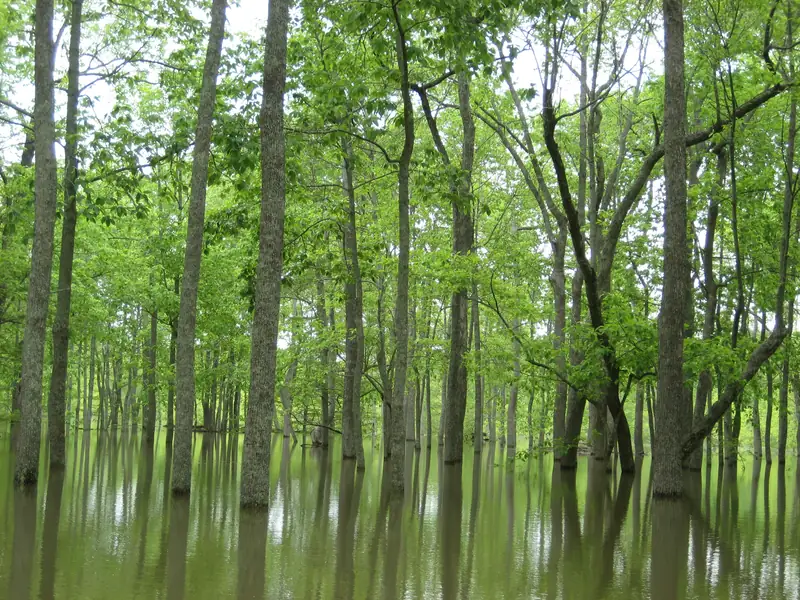
Where nothing's written, give more room than you think you need. In open water, 200 yards or more keeps shot from falling on another party and gives both groups a chance at working birds. In timber, where sight lines are short, the right distance is "far enough that you can't hear their calls clearly." If you can see their decoys, you're too close.
Also respect flight lines. Setting up between another party and the direction birds are coming from (on the "upwind" side, cutting off their birds) is crowding even if you're 300 yards away.
Check the rules and the water
Confirm this season’s rules on our state law pages or the agency’s own site, check draw and permit deadlines, and look at today’s river levels on the migration map. Areas can close or flood on short notice.
Lights, boats and ramps in the dark
- Get ready before you back down. Load the boat in the parking lot, not on the ramp. Launch fast, park, and get out of the way. The opener ramp is where most tempers flare.
- Run with navigation lights and slow down near other lights.
- Point spotlights down. Never sweep another boat or blind with a spotlight. Kill it when you're near a set-up party.
- Idle past set-up hunters after shooting time, and steer wide of their spread. Never run through someone's decoys.
- Don't run back and forth looking for a hole once shooting time comes. If you haven't found a spot by legal light, settle for what you have or wait for a lull to move.
Shooting manners
- Don't sky-bust. Long shots at high birds wound ducks and flare them away from everyone. If the birds are circling another party's spread, they're not your birds.
- Don't shoot over another party's decoys or at birds working them.
- Count your birds out loud. Opening weekend often brings lots of wood ducks and teal early; group counts drift. See our duck ID guide for the species limits.
- Chase cripples promptly, and if a bird falls near another party, ask before you go get it.
Quitting time is etiquette too
Quitting times are what let birds rest so there are ducks the next morning. They're also the law. A few to know for the opener:
- Arkansas WMAs: shooting ends at noon from Nov 21 to Jan 30 unless the area's rules say otherwise, and you must be off flooded areas by 1 p.m. (noon at Dave Donaldson Black River and Bayou Meto) (AGFC Guidebook p. 41).
- Louisiana WMAs and public lands: new this season, waterfowl hunting ends at 12 noon, except on Atchafalaya Delta and Pass-a-Loutre WMAs (LDWF).
- Reelfoot WMA: 3 p.m. Central most days (TWRA).
- Mississippi draw-hunt units: on many units shooting ends at noon and hunters must be out by 1 p.m. (MDWFP).
Our state law pages list the rest.
Leave it cleaner than you found it
Public land stays open because hunters take care of it. Several of the cleanup habits are rules:
- Pick up your empty shells. Mississippi WMAs require it (MDWFP WMA rules).
- Take your decoys and blind home. Arkansas WMAs don't allow decoys, dog stands or platforms left overnight, with a few exceptions, and blinds must come out within an hour after shooting hours end (AGFC Guidebook p. 41). Louisiana WMAs prohibit unattended decoys, and blind frames must be removed within 2 hours after legal shooting time (LDWF p. 52).
- Don't cut timber. Arkansas WMAs ban chainsaws, hatchets and other cutting tools; knives and pocket saws are fine (AGFC Guidebook p. 41).
- Pack out trash, including other people's if you can.
The best way to beat the crowd: hunt somewhere else
The truth about opening weekend is that the famous spots will be packed no matter what you do. Some ways to have a better morning:
- Hunt a weekday if you can.
- Try a draw. Arkansas' weekly permit draws and Tennessee's quota hunts give you a spot nobody can crowd (Arkansas draws, Tennessee quota hunts).
- Go small. Walk-in and kayak water that big boats can't reach often has fewer people. Waders and a dozen decoys go a long way.
- Go late. By the second segment, crowds thin and birds have settled.
A little gear that keeps the peace
A good headlamp with a red-light mode lets you work in the boat without blinding the party next to you. A small, bright spotlight with a narrow beam, pointed only where you're going, is better than a wide floodlight. A mesh decoy bag with backpack straps from a well-reviewed waterfowl maker such as Hardcore Waterfowl makes it easy to pull a spread fast at quitting time.
FAQ
Who has the right to a spot on public land?
By custom, the first party set up and hunting. Some areas put it in writing, like Cache River NWR and Tennessee's Tier 4 blinds (USFWS; TWRA).
How far apart should duck hunters set up?
Follow the written rule where there is one, such as 100 yards on Cache River NWR or 200 yards from blind locations on Tennessee draw areas. Elsewhere, 200 yards or more in open water is a good rule of thumb.
When does Arkansas duck season open in 2026?
Nov 21, 2026 (AGFC, checked Oct 22, 2026).
Do I have to pick up my shotgun shells?
On Mississippi WMAs, yes (MDWFP WMA rules). Everywhere else, it's the right thing to do.
Dates, rules and prices on this page were last checked Oct 22, 2026. If an agency page and this article disagree, the agency page wins.
See something wrong or out of date? Report a correction.
We hunt public water in the Mid‑South and write from the agencies’ own pages. Every rule, date and fee links to its official source and shows the day we checked it. Where we couldn’t confirm something, we say so.
How we check our facts